Survival Tips for Delverium
Night zombies, goblin sprints, empty food stacks, and wall gaps — the kills that surprise new players and how to prevent them before they happen.
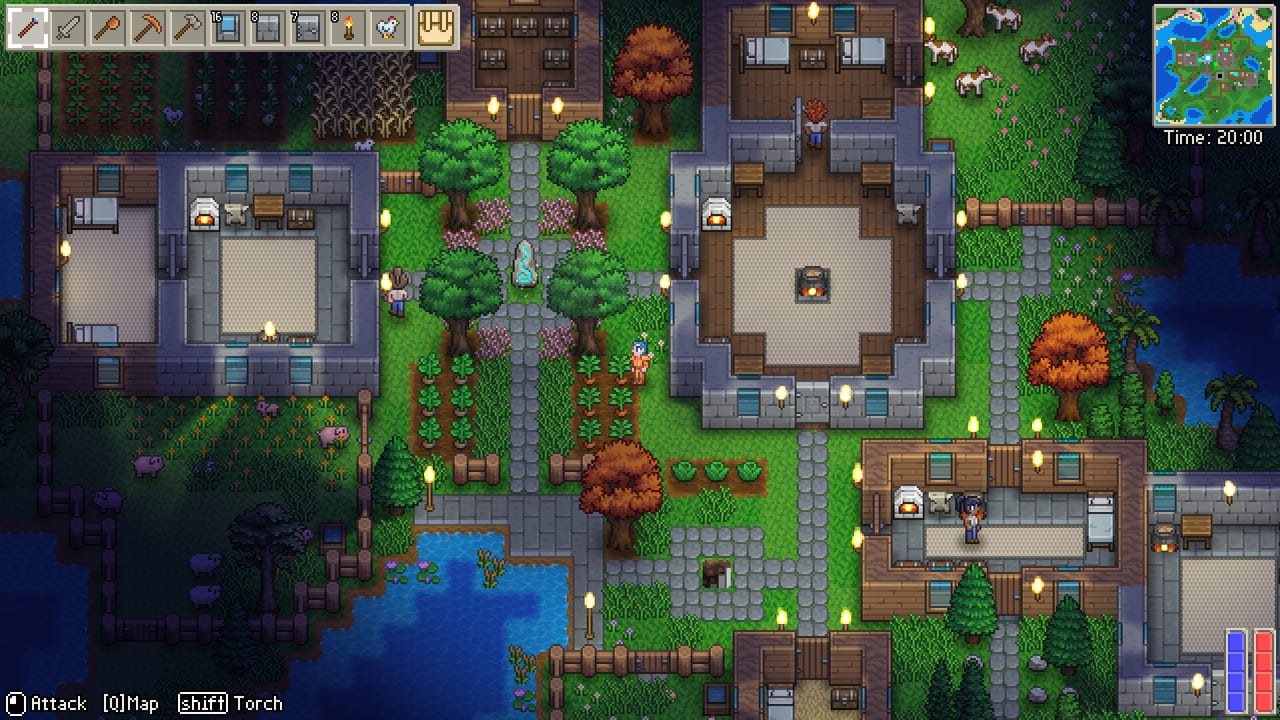
Delverium is not a punishing game, but it is an honest one. The things that kill you in the first hours are not complicated. They are not hidden mechanics or secret damage spikes. They are the same five mistakes every preview player made: forgetting the door, sprinting too far, carrying nothing into a cave, building walls with gaps, and assuming the game would wait. This page is a first-hours survival guide based on the free demo, public playtests, and preview writeups. It will not invent boss strategies or dungeon mechanics that Sagestone has not shown. It will tell you why players die on day one and how to stop doing that.
Steam Early Access is scheduled for September 22, 2026. The free demo has been on Steam since February 2025. Early Access may adjust enemy aggression, night timing, or loot tables. Treat the patterns below as demo-tested constants unless the store page explicitly changes them.
If you have not built a shelter yet, open getting started first. This page assumes you can close a door. It builds on that page rather than repeating it.
The five first-hour deaths
Preview players died to the same five causes across different playtests and preview sessions. These are not opinions. These are reported patterns.
Death one: no door at night
Night in Delverium brings zombies. Preview players who were mid-build when the sky changed learned this the hard way. The door is not optional. A rectangle of walls with no door is a decorative fence, not a shelter. Close the door every night. Not eventually. Not after you finish placing the last wall. Before the sky changes.
The door rule applies even if you are in a cave. A cave with no placed torches and no closed door is where bats and the undead find you. Place torches on the ground so you can see the gap in your wall. Do not hold a torch and hope the held light counts.
Death two: sprinting toward interesting things
The second death is “I wanted to see the coast.” Delverium’s procedural world is designed to make you curious. Water at the horizon, ore glints, a cave entrance in the distance. New players sprint toward all of it. Goblins, bats, and worse live between spawn and interesting things. Preview players who died twice in the first hour almost always described a sprint toward something that looked worth exploring.
Set a mental radius on hour one. Everything you chop, mine, or gather should be close enough that you can sprint home when the sky turns. The map is not going anywhere. The coast will still be there when you have walls, a bed, and a torch on the hotbar.
Death three: no food in a dungeon
The third death is empty pockets in a cave. Preview players described cooked food as health recovery rather than a hunger meter they had to babysit. Whether the health system changes in Early Access or stays the same, the principle does not: take food into dungeons. Raw forage keeps you alive while you build. Cooked food is what you carry into dungeons.
A dungeon run with no food is a speedrun to a bad death. Cook at home, pack a stack, leave. If you forgot food, go back. The cooking and farming guides cover the food loop. This survival rule is simple: if the chest by your door has no cooked food, do not walk into a cave.
Death four: walls with gaps
The fourth death is a bat or a zombie standing in your base because you left a one-tile gap “for later.” Delverium enemies path toward open space. An unfinished wall is not a wall. It is a door you forgot to place.
Before you sleep, walk the perimeter of every structure you have built. Count the walls. Check the gaps. If you placed a wall and then removed it to place a door in the wrong spot, that gap counts too. Enemies path through removed walls.
The gap rule also applies to fence pens. An incomplete livestock fence is not a pen. Critters and livestock can escape; enemies can enter. See farming for pen requirements and pets for critter room rules.
Death five: assuming the game waits
The fifth death is assuming Delverium has a pause button during building or crafting. It does not. Night comes. Enemies spawn. If you are standing still placing walls at dusk, you are building while the world moves.
This is not a complaint. It is a design note. Delverium is a real-time survival-builder, not a turn-based planner. Build during the day. Cook during the day. Walk the perimeter before dark. Use Journey shrines to fast-travel home if you are far away when the sky changes. See shrines for fast travel mechanics.
First-night survival checklist
Based on demo recordings and preview writeups, a first-night checklist that prevents the five deaths above:
- Walls on all sides. Count them. Walk the perimeter.
- A door that closes. Place it, then test it. Open and close it.
- A light source inside. A torch on the ground. Held light does not count.
- A bed. Sleep sets your respawn. If you die without a bed, you respawn at the world origin or a default spawn point.
- Food in a chest by the door. Cooked if you have a station; forage if you do not.
- Tools on the hotbar. Axe, pickaxe, hammer, torch. The controls guide covers the hotbar.
- No open inventory during night. If the game is real-time, your inventory screen is not a pause.
Early resource management
Survival in Delverium is half avoiding death and half managing resources. Preview players who survived the first night often ran into trouble on day two when their inventory was full of low-value materials and they had no room for copper.
The expandable inventory is a selling point, but the first upgrade is not free. Before you fill every slot with straw, fiber, and stone you “might need later,” craft a chest and place it next to your shelter. Sort as you go:
- Tools and weapons stay on the hotbar or in a dedicated chest near your workbench.
- Building materials — wood, stone, fiber — stay in a chest near your build area.
- Ore and refined bars stay in a chest near your furnace.
- Food and forage stay in a chest near your cooking station or spawn point.
When the inventory is full and you are standing next to a chest, sort before you walk away. An inventory full of straw at the entrance to a dungeon is a problem you created, not a game flaw.
See crafting for chest and storage mechanics, farming for food management, and advanced tips for high-efficiency sorting patterns.
Enemy patterns and how to read them
Preview players identified several enemy patterns that are consistent enough to call out:
Zombies — night spawn, slow, pathfinding
Zombies spawn at night and path toward player structures. They do not jump or climb. They enter through gaps. A closed door stops them. A one-tile gap in your wall lets them in. They are slow enough that you can out-walk them if you are outside, but once inside your base they will stand in your bedroom until you deal with them.
The counter is perimeter discipline. Close the door. Check the gaps. Zombies are not a combat challenge on night one. They are a building audit.
Goblins — daytime aggression, faster than you think
Goblin-type enemies in the demo were more aggressive than zombies and faster on foot. Preview players who sprinted toward ore nodes or coastal areas encountered goblins that were harder to disengage from. Goblins do not wait for night. They are a daytime threat.
The counter is situational awareness. If you are far from base and see movement, assume it is hostile until proven otherwise. A torch on the ground gives you light; a sword on the hotbar gives you options. See combat for weapon fundamentals.
Bats — cave spawn, flying, small hitbox
Bats spawn in dark enclosed spaces and fly toward sound and movement. A bat in your base is usually a bat that flew through a gap you left open. They are not dangerous alone, but three bats in a dark room where you are trying to place walls are a distraction that gets you killed by something else.
The counter is torches in dark spaces and closed doors. Bat spawns in caves require light to suppress. If you hear high-pitched movement in a dark corridor, place a torch before you keep building.
Ghosts and spectres — dungeon threats, harder to fight
Ghosts, spectres, and similar incorporeal enemies appear in dungeon runs rather than on the surface. Preview players described them as harder to fight than surface enemies — less predictable patterns, possibly incorporeal damage resistance. A ghost in a dungeon is not a night-one threat; it is a gear-check enemy.
The counter is preparation. Torch the corridor. Carry food. Do not engage a ghost with empty pockets. See dungeons for dungeon run fundamentals and first boss for the early boss fight.
Water and environmental hazards
Delverium’s procedural world includes water tiles, lava pools, and potentially other environmental hazards that kill you regardless of enemy density.
Water tiles in the demo were not swimmable in the traditional sense. Players who walked into deep water stopped or drowned. The safe approach is to treat water edges as hard boundaries until you know whether your build supports swimming. Water-adjacent token spawns are documented in advanced tips; approach water for tokens with the same caution you apply to any hazard.
Lava pools, if they exist in your build, are instant or near-instant death. There is no fireproof buff in the demo that would make lava traversal safe. Treat lava as a permanent barrier, not a resource to harvest.
Journey shrines near water or lava edges can still be activated. If you find a shrine at a dangerous location, activate it for the fast travel point and step back. See shrines for shrine mechanics.
When to call for help in co-op
If you are playing co-op, survival is a shared responsibility. The host world runs on the host PC. If the host is dying, the world continues. Call for help before you are on zero health, not after.
Split-screen co-op with four players on one TV is where the survival checklist gets complicated. One player builds while another gathers while a third waters the farm. Assign roles before night. If nobody is assigned to “close the door,” the door stays open.
Voice chat helps in split-screen. Text chat in online co-op is slower than voice. If your group uses push-to-talk, bind a key that does not conflict with your hotbar. See controls for binding recommendations and co-op for multiplayer fundamentals.
A first-hours survival summary
Do not die on night one. That is the summary. Everything else on this page is detail.
Close the door. Check the gaps. Carry food. Do not sprint toward the coast. Do not assume the game pauses. Set a mental radius on hour one. Build a chest and sort your inventory. Read getting started if you have not built a shelter yet.
Delverium is a game about building a life in a world that does not stop. The first hours are a tutorial in real-time consequences. Once you have a closed room, a stocked food chest, and a mental map of what kills you, the game opens up. You can explore further, build larger, and take the risks that make the mid-game interesting.
The guides hub has the full library. The dungeons guide takes over when you have food and a torch. The farming guide takes over when you want to stop dying to empty pockets. The review decides whether you want to keep playing before you commit to the farm. Read what you need, then close the door.
Frequently Asked Questions
Quick answers to the most common Delverium questions.
Why do I keep dying on the first night in Delverium?
Most first-night deaths are from open doors, wall gaps, or building during nightfall. Close the door before the sky changes. Walk your perimeter before you sleep. Delverium is real-time; it does not pause while you place the last wall.
What enemies spawn at night?
Zombies spawn at night and path toward player structures through gaps. Goblins are daytime threats. Bats spawn in dark enclosed spaces. Ghosts and spectres appear in dungeon runs. See the enemy patterns section above.
How do I avoid dying to goblins?
Goblins are faster and more aggressive than zombies. They are a daytime threat, not a night threat. Stay alert when exploring far from base. Carry a weapon on your hotbar and disengage if the fight goes badly.
Should I carry food into dungeons?
Can I swim in Delverium water?
Deep water in the demo was not safely swimmable. Treat water edges as hard boundaries until your build confirms swimming support. Lava pools are instant or near-instant death. Activate Journey shrines near water but step back immediately.
How do I survive co-op with friends?
Assign roles before night. One person closes the door. One person waters the farm. Call for help before you are at zero health, not after. Voice chat is faster than text. See co-op.
What is the most common mistake new players make?
Sprinting toward interesting things (ore, coast, caves) before having walls, a closed door, and food. Set a mental radius on hour one. Everything useful is close enough to sprint home when the sky turns.